

Senate Bill 9 (SB 9) was a landmark housing bill passed by the State of California in 2021. It changed how local governments control single-family zoning. In single-family residential zones, the law lets homeowners split their lots and build up to four homes, either through duplexes, lot splits, or both. This is meant to help with the state’s serious housing shortage. SB 9 basically gets around normal zoning restrictions and needs ministerial approval for certain types of projects.
There could be up to four units on lots that were only big enough for one, which would increase the number of homes. The law has strict requirements for who can be eligible, such as protecting the environment, stopping people from being forced to move, and preserving historic sites. When it comes to projects, local governments can only turn them down if they pose a clear threat to public health or safety. The law is not being looked at by CEQA, and it is backed up by state housing laws such as the ADU law, the Housing Element Law, and the Housing Accountability Act.
There is a lot of conflict between state housing goals and local power in the San Gabriel Valley (SGV), which has a lot of history, a suburban feel, and a lot of different government agencies. This article looks at how cities like Azusa, Covina, West Covina, Monrovia, and Glendora have reacted to SB 9.
SB 9: The Law at a Glance
SB 9 has two key components:
- Urban Lot Splits: A single-family lot can be split into two, with restrictions (e.g., only once per parcel).
- Two-Unit Developments: Each lot can contain up to two primary residential units, allowing a total of four units per original parcel
Key Features of SB 9:
- Requires ministerial review, bypassing planning commissions and public hearings.
- Applies only in single-family residential zones.
- Units must be at least 800 sq. ft. unless physically infeasible.
- Cities must waive objective standards that would prevent unit creation or lot splits.
Excludes projects that displace renters, affordable housing, or are located in environmentally or historically sensitive areas.
Does not trigger CEQA (California Environmental Quality Act) analysis.

San Gabriel Valley: Why It Matters
The SGV is home to more than 30 cities, including both urban hubs like Pasadena and suburban enclaves like Glendora. Many SGV cities are predominantly zoned for single-family housing, and lot sizes vary, making SB 9 particularly potent. The implementation—or obstruction—of SB 9 in these cities offers insight into the challenges of statewide housing reform at the hyper-local level.
A place where single-family zones are very prominent
The SGV is known for its history of suburban growth after World War II. Most of the land in the area is zoned R-1, which means it can only be used for single-family homes. This pattern of zoning has caused low living density, few chances for infill development, and rising housing costs as population and demand have grown. As an example,single-family zoning is still a big part of the land use plans for towns like San Marino, Temple City, and La Verne.
SB 9 directly questions this structure by letting two-unit developments and lot splits happen by-right in places where only one home could be built on each parcel before. Because of this, the SGV is a key place for testing how well SB 9 can increase the supply of new homes in suburbs.
Population Growth Causes Pressure on Housing
- More than 2 million people live in the SGV, and there are large groups of:
- Asian-American neighborhoods (mostly in Arcadia, Rowland Heights, and Monterey Park)
- Families from Latin America and other countries (mostly in El Monte, Baldwin Park, and Azusa)
- Homeowners over 65 who are on a fixed income
- Young renters and working-class families who are having trouble finding homes
This mix makes housing needs conflict: older residents often want security and to keep their neighborhoods safe, while younger people and renters want housing that is affordable and available. SB 9 tries to close this gap by letting homeowners build more homes, so there’s no need for speculative investors or full-scale redevelopment.
Below are examples of how SB9 could be used.
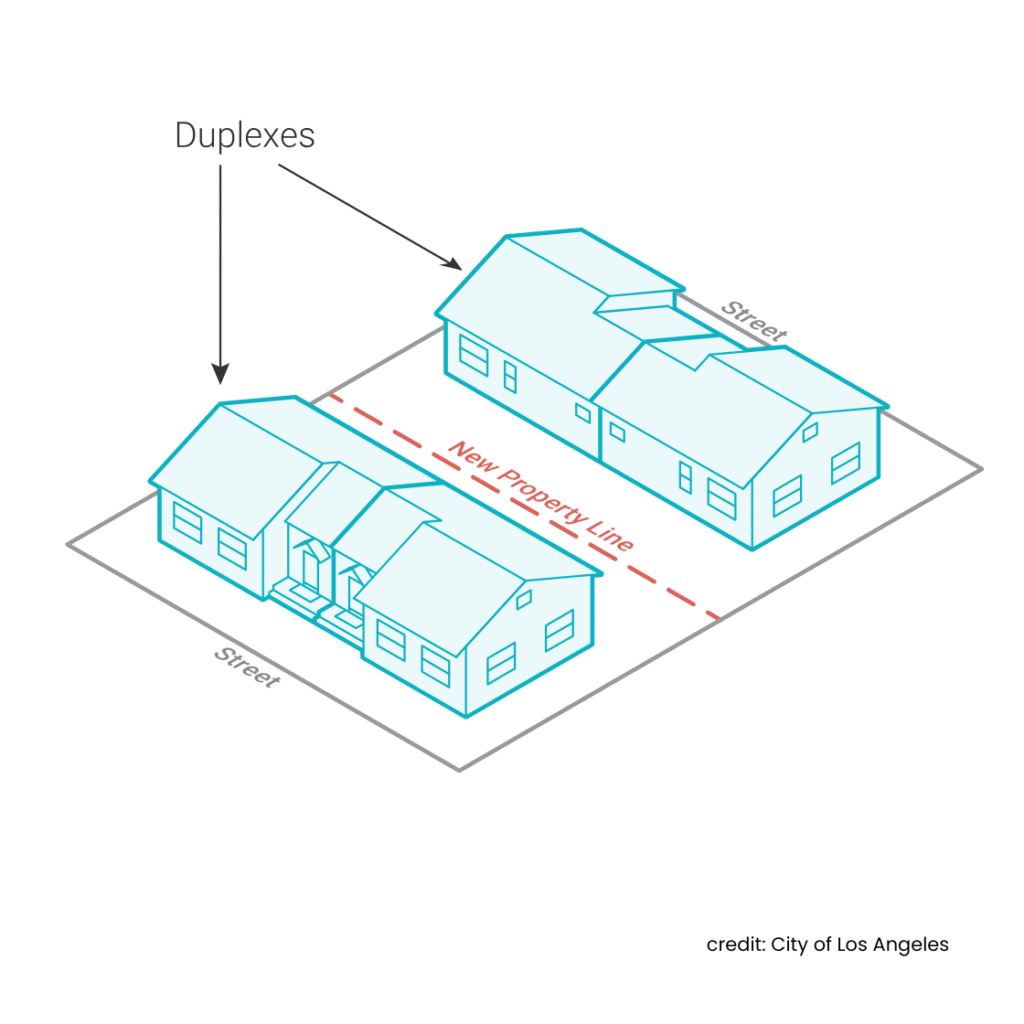
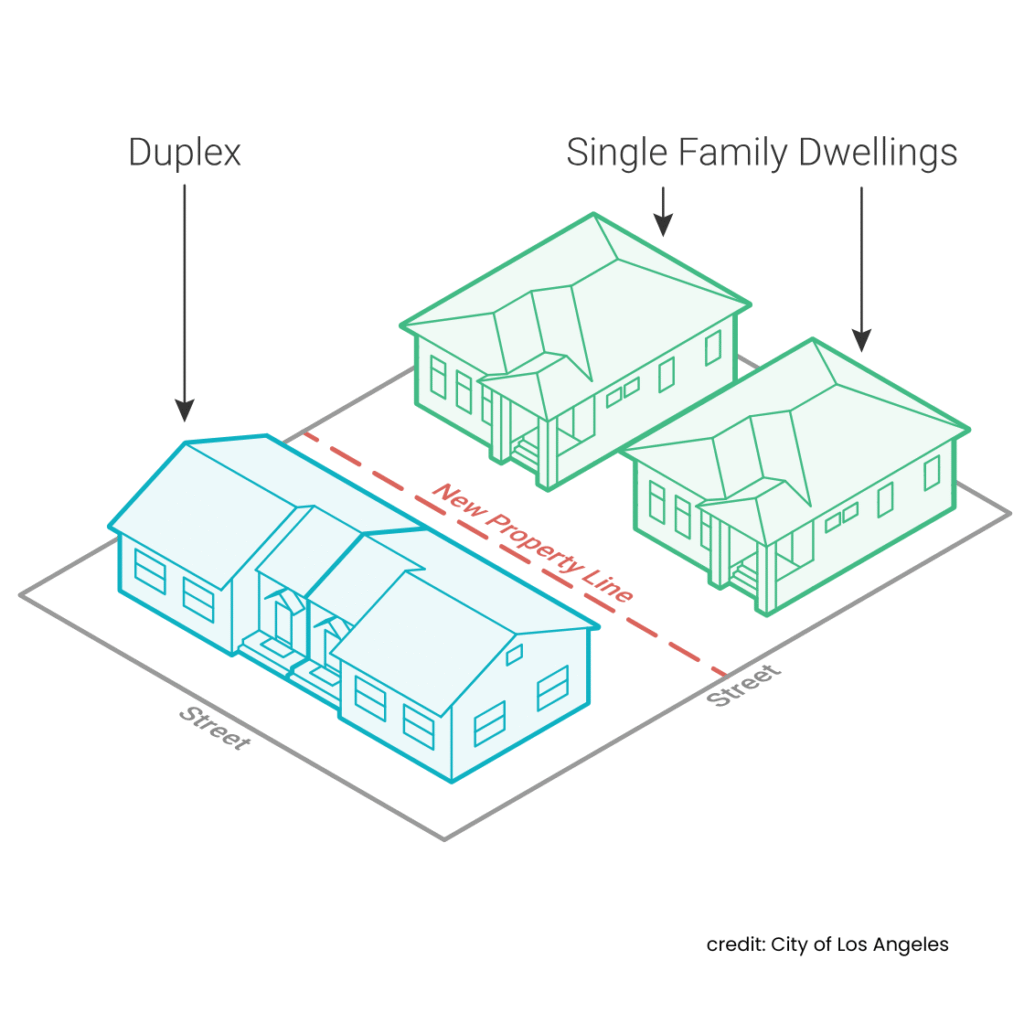
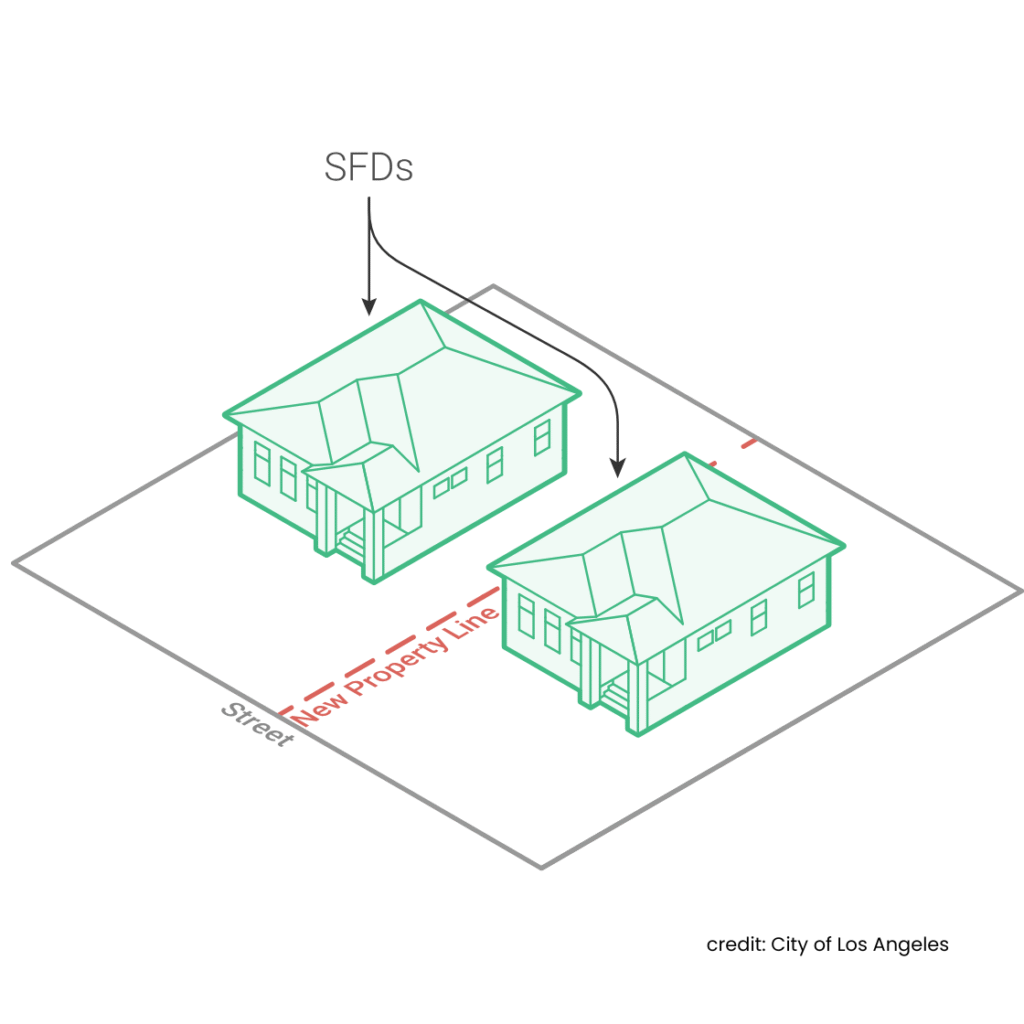
How SB 9 Works
Ministerial Review
Applications made under SB 9 must be processed ministerially, without public hearings or subjective review. Staff reviews applications against objective standards using checklists, avoiding any discretionary judgment.
Objective Standards and Modifications
Local agencies may apply standards related to:
- Setbacks
- Building height
- Lot size and depth
- Roof design and façade materials
However, if these standards would prevent the construction of two units of at least 800 square feet each, they must be modified or waived.
Development Rules and Limits
Setback Requirements
SB 9 mandates:
- No setbacks for existing structures or reconstructions on the same footprint
- Maximum 4-foot side and rear setbacks for new construction
Cities cannot impose greater setbacks than these.
Here are some cities in the San Gabriel valley that are implementing this new law.
Case-by-Case Review of SB 9 Implementation
✅ City of Covina
Status: Fully compliant, ministerial process in place
Lot Split + Duplex: Allowed
Objective Standards: Local checklist used
Website Access: Inconsistent; official SB 9 page down as of July 2025 (at the time of writing this article)
Though Covina’s SB 9 webpage was temporarily unavailable, internal planning documents and housing element updates confirm that Covina complies with SB 9. Staff process SB 9 lot splits and duplex applications at the administrative level using objective criteria.
Example: A homeowner on a 10,000 sq. ft. lot in R-1 zoning can file a ministerial application to split the parcel and build two duplexes—adding four units total, assuming environmental and tenant constraints don’t apply.
City Quote: “The City of Covina shall process SB 9 urban lot split and duplex applications ministerially, pursuant to Government Code Sections 65852.21 and 66411.7.”
✅ City of West Covina
Status: SB 9 ordinance adopted (2022)
Lot Split + Duplex: Allowed by right
Objective Standards: Staff checklist enforced
West Covina has taken a proactive approach by adopting a local ordinance that facilitates SB 9 development while retaining control over design elements. Projects are approved at staff level as long as they comply with dimensional standards.
City Council Quote: “West Covina will accept duplex and lot split applications on parcels zoned R-1, using a staff-level checklist to evaluate consistency with ministerial approval criteria.”
✅ City of Pasadena
Status: Strong implementation with added design guidance
Lot Split + Duplex: Allowed
Additional Layer: Design guidelines via Ordinance No. 7387Pasadena’s progressive planning history aligns with the goals of SB 9. The city has added objective design criteria, including façade consistency and height limits, but allows all eligible SB 9 projects to proceed without discretionary review.
Notable Practice: Pasadena uses an online eligibility verification tool and has clear diagrams for building envelopes and lot split configurations.
City Planning Dept. Quote: “SB 9 projects in Pasadena must comply with objective design standards adopted in Ordinance No. 7387. The City allows for ministerial approval of duplexes and urban lot splits.”
✅ City of Monrovia
Status: Fully compliant, published SB 9 guidance
Lot Split + Duplex: Allowed with objective standards
Public Outreach: Workshops and online forms
Monrovia has aligned its planning process with state requirements, issuing clear handouts for property owners and publishing eligibility FAQs. The city treats SB 9 projects as administrative applications.
Planning Division Statement: “The City has created a ministerial review process for SB 9 projects. A duplex or lot split may be approved by staff if the application meets objective standards in the Monrovia Municipal Code.”
⚠️ City of Glendora
Status: Partially implemented; under state scrutiny
Lot Split + Duplex: Allowed, but subject to design review
Concerns: Added architectural review may conflict with SB 9
Glendora’s Housing Element acknowledges SB 9, but public comments and developer feedback suggest that extra hurdles are in place. The city enforces subjective architectural standards under the guise of “compatibility,” which may violate SB 9’s requirement for objective review only.
Housing Element Quote: “Glendora recognizes SB 9’s mandates and will allow eligible projects to proceed. Additional architectural review may be applied, but not to the extent it prevents development.”
✅ City of Azusa
Status: SB 9 fully integrated into permitting process
Lot Split + Duplex: Allowed ministerially
ADU + JADU Compatibility: Coordinated with ADU law
Azusa has openly embraced SB 9, encouraging infill development and offering streamlined application packets for duplexes and lot splits. The city is seen as a model for compliant and pro-housing cities in the SGV.
Planning Department Quote: “Urban lot splits and two-unit developments are permitted as of right under SB 9. Applications are processed administratively in accordance with state law.”
Key Patterns and Legal Insights
1. Most cities allow SB 9 development, but implementation varies in transparency.
Some (like Azusa and Pasadena) offer public tools and FAQs. Others (like Covina and Glendora) lag behind in digital transparency.
2. Lot size and configuration matter.
Many SGV lots are irregular or slope-impacted (especially in hillside zones like Glendora and Monrovia), which can complicate lot splits under SB 9.
3. Cities adding “design review” may risk legal challenges.
Under SB 9, only objective design standards are allowed. Any requirement for “compatibility” or “neighborhood character” is likely unlawful.
4. ADUs and JADUs complicate unit counts.
If no lot split occurs, cities must still allow ADUs under separate ADU law. But with a lot split, SB 9 caps units at two per lot—including ADUs.
What Homeowners Should Know
Do’s | Don’ts |
✅ Confirm R-1 zoning eligibility | ❌ Don’t propose demolishing a tenant-occupied unit |
✅ Prepare a site plan with setbacks | ❌ Don’t apply if your parcel is in a fire/historic zone |
✅ Include at least 800 sq. ft. units | ❌ Don’t expect discretionary hearings or appeals |
✅ Consult ADU laws for combos | ❌ Don’t assume subjective design review applies |
Future Trends to Watch
- Litigation & State Enforcement: Glendora and other cities with added review layers may be investigated by California’s Housing Accountability Unit.
- Data Portals: Pasadena and Azusa are expected to release public SB 9 permit tracking dashboards in 2025–2026.
- Regional Coordination: SGVCOG (San Gabriel Valley Council of Governments) may develop joint guidelines or incentives for compliant SB 9 adoption.
Conclusion
SB 9 has already changed the housing landscape in the San Gabriel Valley. Cities like Pasadena, Monrovia, and Azusa serve as models of compliance, while Covina and West Covina show that even historically suburban cities can adapt. However, lingering resistance in Glendora and other jurisdictions underscores the friction between state policy and local autonomy.
For homeowners, developers, and advocates, understanding the local interpretation of SB 9 is essential. The future of housing in California will depend not just on the existence of laws—but on their fair, timely, and transparent implementation. The law is both a challenge and a chance in the San Gabriel Valley, which was deeply changed by the growth of suburbs after World War II.
From this regional look, it’s clear that SB 9 isn’t being followed the same way everywhere. By using SB 9 in their planning processes, towns like Pasadena, Azusa, and Monrovia have shown they are serious about meeting the state’s housing goals. They’ve made clear rules, agreed on objective standards, and set clear paths for homeowners to follow when they want to build.
On the other hand, towns like Glendora show where SB 9 enforcement isn’t right. Some places have added design reviews, narrow interpretations of “objective standards,” or bureaucratic hurdles that may discourage applicants or slow projects, even though it’s against the letter of the law. This goes against what SB 9 was meant to do.
SB 9 gives homes more freedom. Property owners who were limited to a single unit can now build wealth, provide housing for generations, or make a small amount of rental income—all without having to work with developers or go through a full rezoning. Protecting tenants and excluding harmful environments are some of the laws in SB 9 that make sure this crowding doesn’t hurt communities that are already struggling.
But SB 9 forces cities to change the way they think. Now, planners and governments have to find a balance between protecting the character of neighborhoods and following the Constitution’s requirement to build more homes. Cities that don’t follow SB 9 correctly could be sued or have the state step in through the Housing Accountability Unit.
What will happen next that will affect how well SB 9 works in the San Gabriel Valley?
-Whether cities choose to respond in a constructive way instead of an obstructionist way
-How ready homeowners are to put money into small-scale infill
-Whether the services and facilities can grow with the number of units
In a way, the San Gabriel Valley shows how living will change in California in the future. With its varied landscapes, income gaps, and long history of planning, this is a good place for SB 9 to take root. It could work almost anywhere in the state. But that result isn’t a sure thing. Residents will need to be careful, city leaders will need to be brave, and the state will need to be consistent in its regulation. And remember always try to look at your City Council Agenda and Planning Commission to take a view of the agenda to see if these type of Housing reforms are happening in your neighborhood.
